ROBOTICS & IoT / INTERACTIVE LAB
Welcome to SmartSpace.
Change the room. Watch it respond. Explain your evidence.
Browser telemetry
Your SmartSpace
One cumulative model · workbook behaviourSee this activity’s original workbook picture
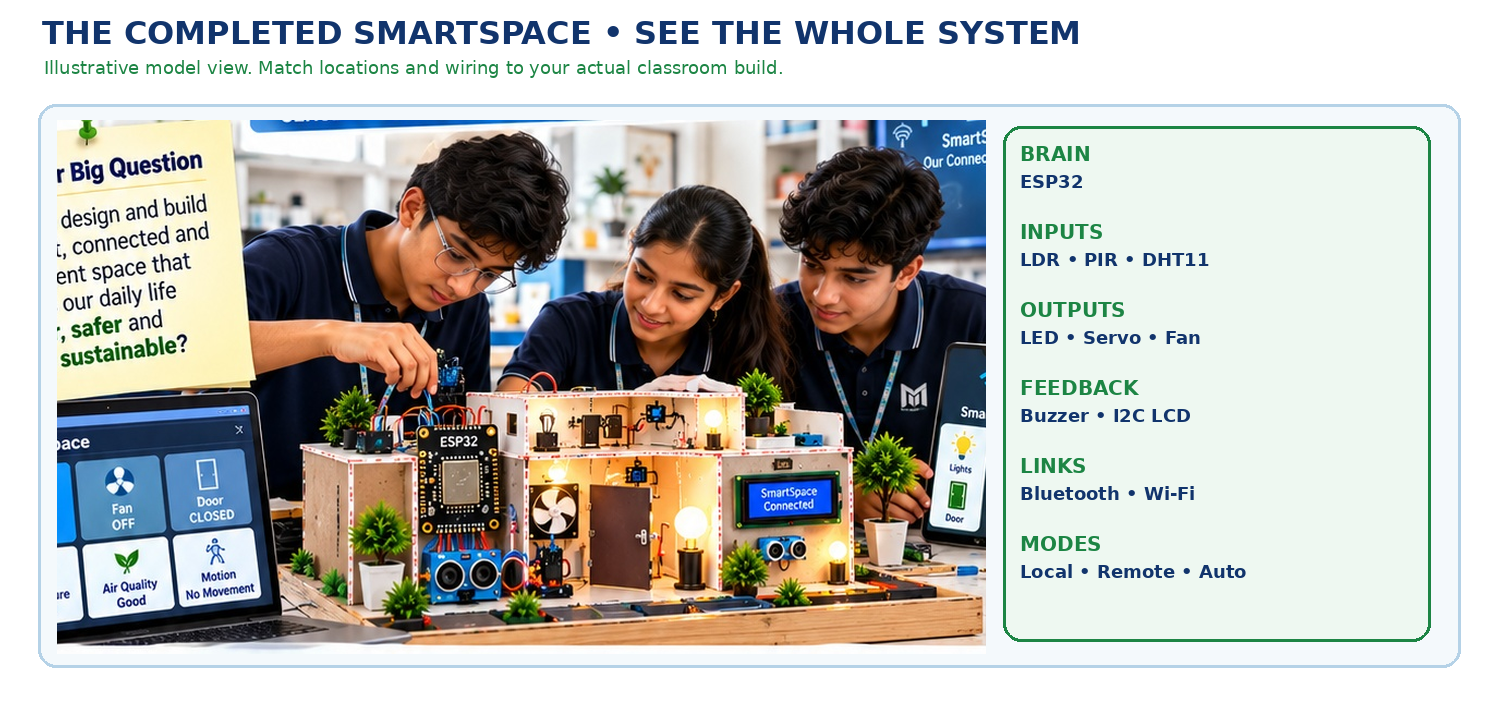
Original workbook artwork. The live illustration above shows simulated output states.
ⓘ A learning model · no real hardware connection
Runs in your browser · no student names, cameras or uploads
Activity 9 preview · select Activity 9 above to follow this workbook section.
ACTIVITY 9 / CAN AI HELP US SAVE ENERGY?
Train. Test. Improve with evidence.
The workbook’s four-hour AI route, with a camera-free browser rehearsal.
Possible waste?
Ask for a review.
Train on the workbook kit’s 40 labelled practice rows. Test on the separate 16 unseen rows.
Same five workbook features
Observed brightness · temperature · PIR event · light state · fan state
This browser uses a small CART-style tree; Orange may learn a different tree. The target is Possible_Waste / No_Clear_Waste. Synthetic scores cannot establish real-world accuracy or electricity savings.
Simulate a recognised gesture.
The real workbook uses teacher-operated MediaPipe/OpenCV. Here you choose a pretend prediction. No camera opens.
Try dry run first. Clear the box and choose REMOTE to send a light command. LOCAL / AUTO block it.
Same light.
A better threshold?
Compare the original LDR rule (1600 / 2000) with your limits. Both replay six identical 50-second scenes: five minutes per trial.
- Select AUTO.
- Change one LDR limit. Try a high limit of 1700.
- Compare ON-time and useful lighting.
How is this a fair test?
Both trials start OFF and use the same LDR readings and timing. Enough natural light is a separate simulated human observation. These are example conditions, not a universal ADC calibration.
The five-minute trials replay instantly. We count simulated ON-seconds; we do not measure watts, watt-hours, costs or real savings. People review AI suggestions and choose rule changes.
Your fair-test report
READY TO TESTMeasure before making a claim.
Can you reduce ON-time and keep useful lighting?
| 50-second scene | ADC | Original | Your rule | Adequate? |
|---|
Rules changed. Run the comparison again.
Did the AI review help? Does less LED ON-time prove lower electricity use without measuring power?
Teacher’s corner · workbook alignment and model limits
Based on the Grade 8 SMARTSPACE “Every Activity Final Build Images” workbook. The guide follows all ten activities, with original checkpoint pictures, pin names, code references and the complete workbook.
Controller: two LDR limits; fan ON 29°C / OFF 27°C; fresh PIR edge opens the door 75° with a 150 ms alert and shuts it to 15° after 4 s. Mode changes reset outputs. LOCAL takes over and toggles LIGHT 1.
This browser simulates the reference behaviour. It does not emulate ESP32 firmware or verify wiring. Timers use browser ticks; the buzzer is a visual pulse. Gesture buttons rehearse recognised labels; they are not live recognition.
Real work needs teacher-approved low-voltage power, 3.3 V logic, guarded moving parts and the workbook diagrams. PIR is movement, not guaranteed occupancy. A software mode switch is not a physical emergency disconnect.
Ask each learner to predict, test one change, record an observation and explain an improvement. Use the workbook’s thinking questions and final teacher assessment.